Support Student Changemakers in the Spirit of Chester Wickwire
Help us bring 50 student leaders to the 2025 SLCE Conference to share their service, scholarship, and commitment to community change.
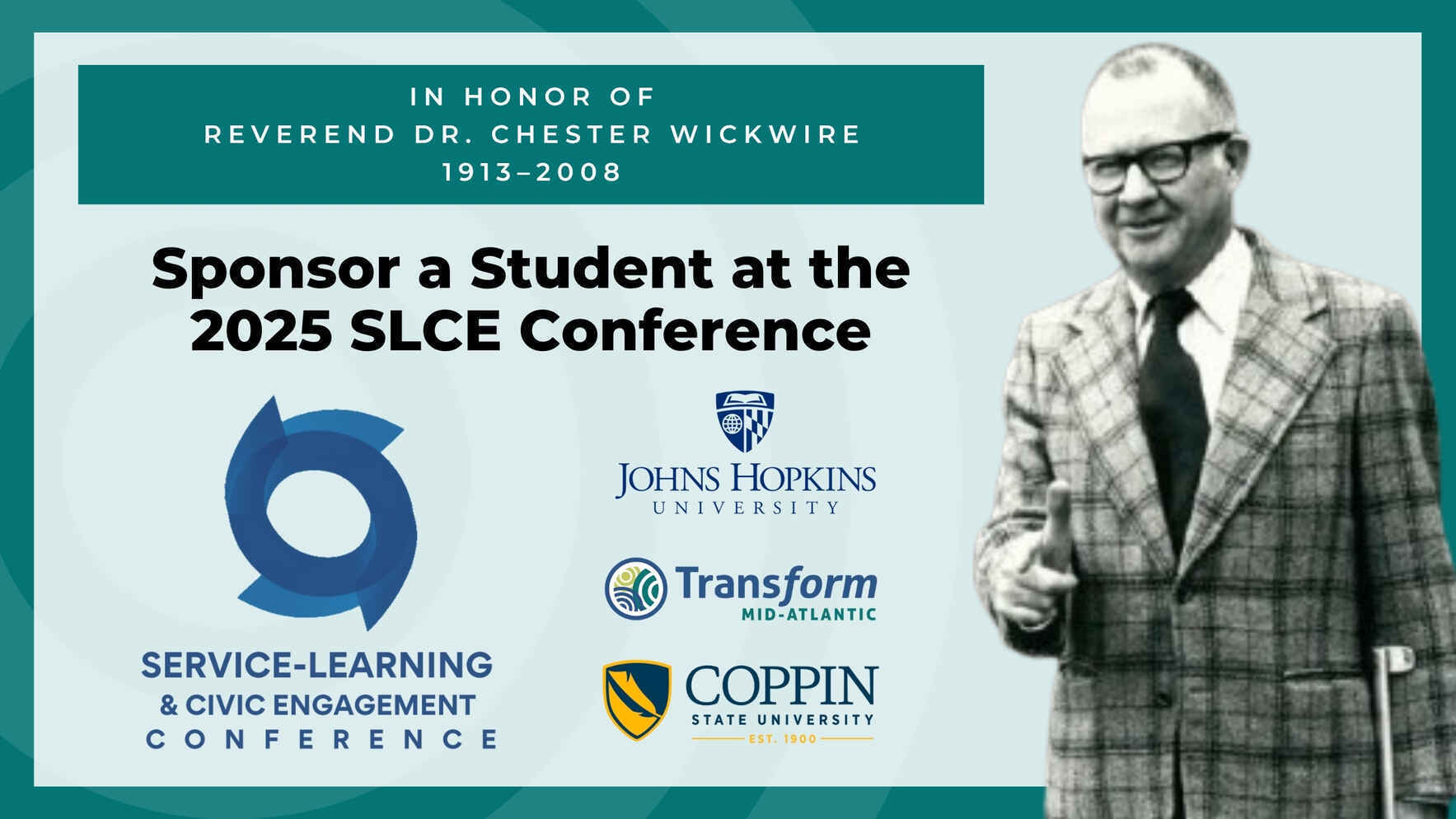
Support Student Changemakers in the Spirit of Chester Wickwire
This October, help us bring 50 student leaders to the 2025 Service-Learning & Civic Engagement (SLCE) Conference—a full-day gathering of students, faculty, staff, and community partners advancing equity, innovation, and service in higher education.
In honor of Reverend Dr. Chester Wickwire—a visionary advocate for social justice, education, and civic action—Transform Mid-Atlantic and the Community-Based Learning Faculty at Johns Hopkins University are raising $3,000 to cover:
- Student registration fees
- A modest honorarium for our keynote speaker
- A visual tribute honoring Dr. Wickwire, our sponsors, and the student participants themselves
Your gift will allow students to lead workshops, present research and service-learning projects, and engage with changemakers from across the Mid-Atlantic—amplifying voices and stories that continue Dr. Wickwire’s legacy of justice, equity, and community-rooted leadership.
👉 Make your gift today in honor of “Chester Wickwire” and help sponsor the next generation of civic leaders.
Together, let’s turn vision into action—and service into transformation.
Rev. Dr. Chester Wickwire's Legacy in Baltimore
Between 1953 and 1981, Dr. Chester Wickwire served as chaplain, instructor, and (until 1969) director of the YMCA at Johns Hopkins University. More significantly, “Chester’s Place”—the café on the second floor of Levering Hall named in his honor—became a welcoming space for students committed to social change. Deeply devoted to supporting the disenfranchised and marginalized, Wickwire helped break down the walls of the ivory tower, encouraging Hopkins students to engage directly with Baltimore’s communities.
Wickwire stood out at a university often hesitant to embrace change. He joined the Congress for Racial Equality in protests to desegregate Gwynn Oak Amusement Park; supported students from Morgan State, Goucher, and Hopkins in their efforts to integrate Northwood Shopping Center; and, as the only white clergyman in the Interdenominational Ministerial Alliance during the mid-1960s, demonstrated his commitment to racial justice. He co-founded the Baltimore Committee for Political Freedom to educate white citizens about anti-Black racism and their own complicity in it. He listened to Black students when few others did, marched in anti-Vietnam War protests, and challenged all students to reflect on their roles at Johns Hopkins, in Baltimore, and the world.